

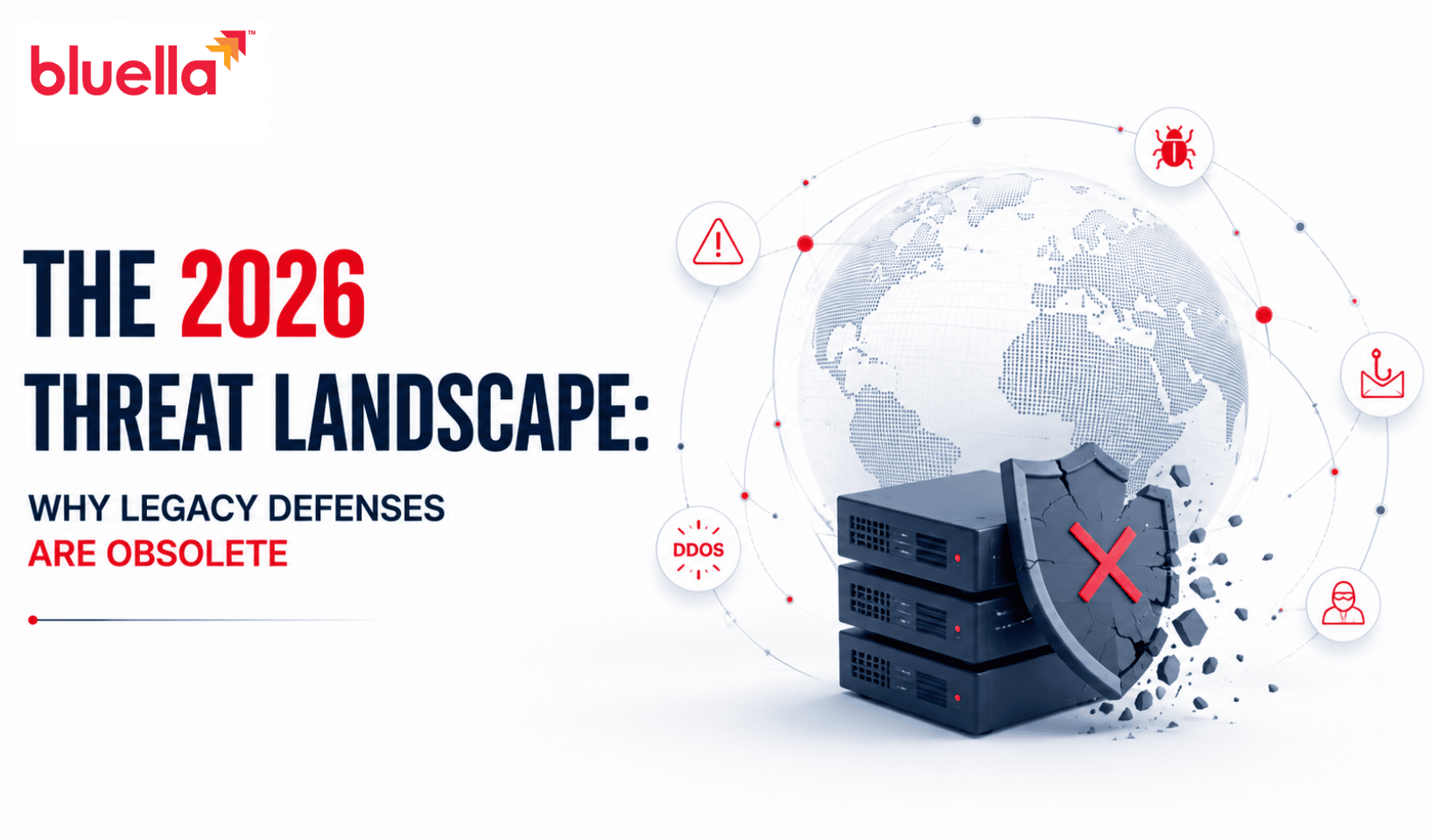
Static firewalls and threshold-based DDoS protection are no longer enough — the attacks targeting your business in 2026 bear almost no resemblance to the volumetric floods those tools were designed to stop.
The threat environment has shifted in three converging directions. First, AI-driven attacks now mimic legitimate human browsing behavior, cycling through request patterns that look normal to any rule-based filter. Second, the target has expanded from the network layer all the way up to Layer 7, where complex application-layer strikes overwhelm specific endpoints — login pages, checkout flows, APIs — rather than simply saturating bandwidth. Third, and perhaps most alarming, the barrier to entry has collapsed entirely. As CISA notes , "the shift toward 'DDoS-as-a-Service' has lowered the barrier to entry so significantly that even non-technical actors can launch crippling attacks." Your business does not need to be a Tier 1 enterprise to become a target. Any revenue-generating application is enough.
The financial stakes reinforce that urgency. The global cost of cybercrime is projected to reach $13.82 trillion annually by 2028, a figure that reflects not just ransomware and data breaches, but the compounding cost of downtime, reputational damage, and lost customer trust that follow every successful attack. Understanding how to stop a DDoS attack before it reaches your users is no longer a technical nicety — it is a core business continuity requirement. The question most organizations are still asking the wrong way is whether their current stack can absorb the attack. The more accurate question is whether it can even detect one that has been engineered to look like normal traffic.
That distinction — between detection and absorption — is precisely where legacy defenses fail, and it points directly to the strategic framework you need to replace them.
From Prevention to Mitigation: A Strategic Framework
You cannot stop a DDoS attack from being launched — but effective DDoS mitigation ensures it never reaches your users or disrupts your operations.
That distinction matters more than most security teams acknowledge. The goal is not prevention in the absolute sense; it is containment, absorption, and rapid response. Shifting your thinking from "block all attacks" to "neutralize their impact" is the foundation of a modern defense posture.
With multi-vector DDoS attacks — combining volumetric, protocol, and application-layer strikes — up 200% year-over-year according to the Neustar International Security Council, a single-layer defense is a liability. A strategic framework has to cover the full OSI stack, not just the perimeter.
A mature mitigation strategy rests on three pillars:
Behavior-based analytics: Static IP blacklisting fails against AI-driven adaptive attacks that mimic legitimate user traffic, per FS-ISAC research. Behavioral analysis identifies anomalous patterns in real time, flagging threats that static thresholds miss entirely.
Multi-vector defense architecture: Volumetric floods, SYN exhaustion, and HTTP request attacks each require different countermeasures. A layered approach addresses every attack surface simultaneously .
Managed DNS and CDN distribution: Routing traffic through geographically distributed nodes absorbs initial surge volume before it concentrates on your origin infrastructure, buying critical response time.
The "prevention myth" is dangerous precisely because it breeds complacency. Organizations that invest in a single firewall rule set and consider the problem solved are the ones that go offline under a sustained, coordinated assault. Accepting that attacks will be attempted — and building to withstand them — is what separates resilient businesses from vulnerable ones. Understanding these pillars sets the stage for the operational decisions that determine whether your team can actually execute when an attack hits.
The Bottom Line: What You Need to Know
Effective DDoS resilience in 2026 demands four non-negotiable capabilities that static firewalls and legacy threshold tools simply cannot deliver.
Automation is mandatory. AI-driven botnets shift attack vectors in milliseconds — far faster than any human analyst can respond. As FS-ISAC confirms , protection now requires behavior-based analytics and automated traffic scrubbing to counter real-time pattern shifts. Manual intervention is a liability, not a safeguard.
Hybrid cloud DDoS protection is the new standard. On-premise hardware provides low-latency filtering close to your infrastructure, but volumetric attacks can saturate local capacity in seconds. Combining on-premise speed with cloud-scale scrubbing capacity — what practitioners call hybrid cloud DDoS protection — absorbs multi-terabit floods without forcing a trade-off between performance and survivability.
Zero-trust architecture closes the API gap. Authenticated traffic only. Protecting API endpoints through strict identity verification and rate-limiting ensures that application-layer attackers cannot exploit unauthenticated entry points to bypass perimeter defenses entirely.
Continuous monitoring is no longer optional. Mission-critical workloads require 24/7 Security Operations Center oversight. Threats do not respect business hours, and delayed detection converts a manageable traffic spike into a costly outage.
And that last point — sustained, expert-led oversight — is precisely where the conversation shifts from tools to strategy. The question is not just what technology you deploy, but who is watching it around the clock.
Securing the Future with Managed Cloud Resilience
The shift toward Managed Security Service Providers reflects a clear operational reality: most organizations lack the in-house expertise to maintain continuous, adaptive DDoS defense on their own. Mid-market and enterprise firms are increasingly outsourcing this function not because they cannot afford internal teams, but because the threat landscape evolves faster than any single security team can track. Understanding how to prevent DDoS attacks is no longer a one-time technical exercise — it is an ongoing discipline that demands 24/7 monitoring, real-time traffic analysis, and coordinated incident response at a scale that managed services are uniquely positioned to deliver.
Regulatory compliance adds another layer of urgency. For organizations operating under HIPAA or GDPR, availability is not simply a performance metric — it is a legal obligation. A prolonged outage caused by a volumetric attack can trigger breach notification requirements, audit scrutiny, and significant financial penalties. In practice, the overlap between DDoS resilience and compliance posture is tighter than most legal teams recognize, and a unified approach to DDoS protection that logs, reports, and responds within defined SLAs is often what separates audit-ready infrastructure from liability exposure.
Bluella addresses this convergence directly. By combining sophisticated security algorithms with 24/7 expert support, Bluella ensures business continuity and regulatory compliance for global enterprises — moving organizations from reactive panic to proactive infrastructure resilience. If your current defense strategy relies on static thresholds and legacy firewalls, 2026 is the year to change that. Contact Bluella today to assess your DDoS exposure and build a mitigation framework your business can actually depend on.