

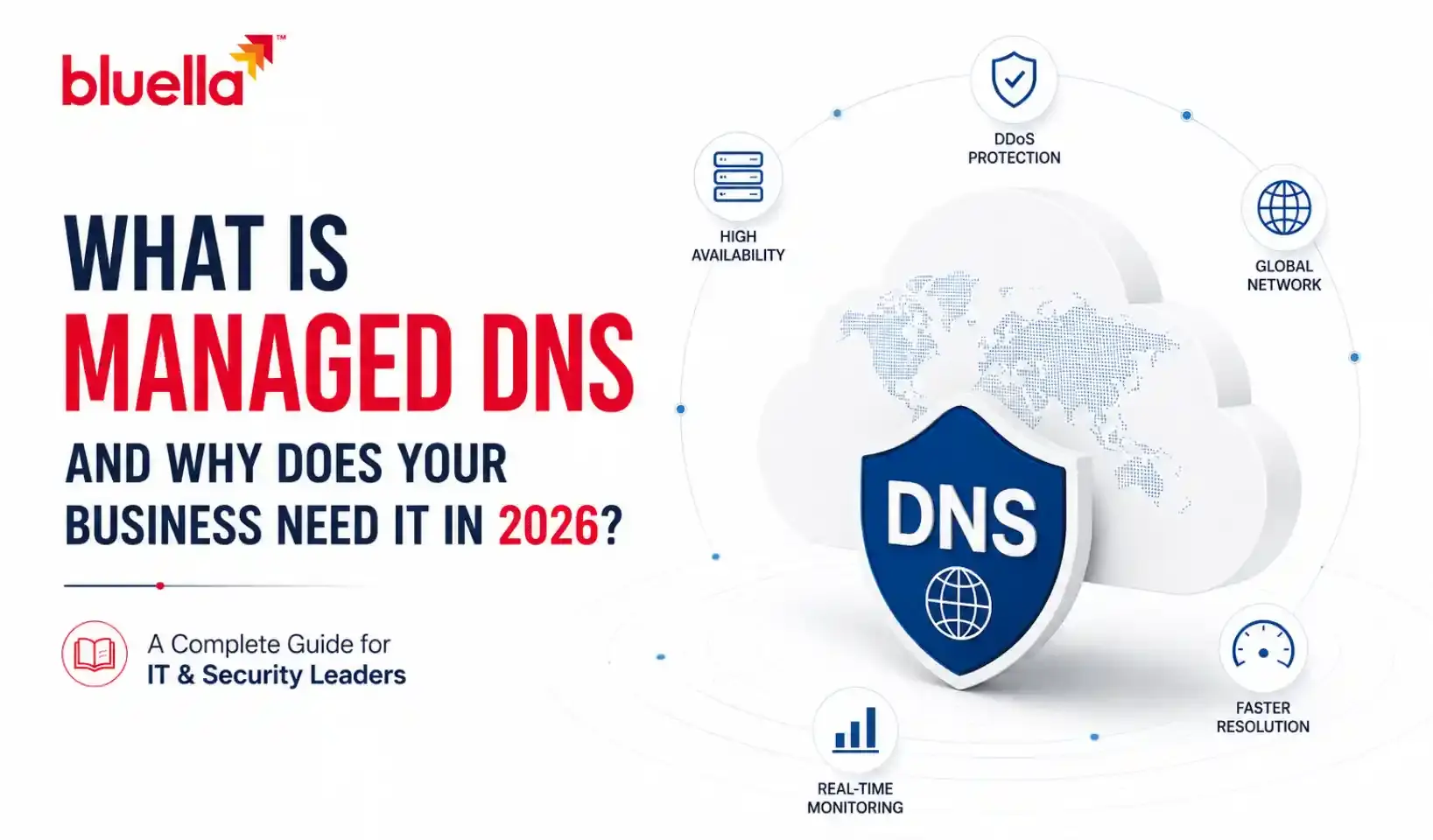
Managed DNS is a service where a third-party provider hosts, monitors, and secures your Domain Name System infrastructure instead of your in-house team managing it manually. It ensures your website, applications, and APIs stay resolvable, fast, and protected from outages or attacks — 24/7, at scale, without you having to run the servers yourself.
If your business runs anything mission-critical online — an e-commerce store, a healthcare portal, a SaaS platform — DNS is the invisible layer that decides whether your customers can reach you at all. Yet most companies still treat it as an afterthought. In 2026, that's a risk few businesses can afford.
What Does DNS Actually Do?
Every time someone types your website address into a browser, DNS translates that human-readable name (like bluella.in) into the numeric IP address a server understands. It happens in milliseconds, billions of times a day, across the internet — and if it fails, your website simply doesn't load, even if your servers are running perfectly fine.
What Is Managed DNS?
Managed DNS shifts the responsibility of running this translation layer to a specialized provider with a global network of DNS servers. Instead of relying on a single server or your domain registrar's basic DNS (which is often slow and has no redundancy), a managed DNS provider gives you:
Multiple points of presence (PoPs) across the globe, so queries resolve from the server closest to the user
Redundancy and failover, so if one server goes down, others instantly take over
DDoS protection built into the DNS layer itself
API-driven management, so DNS records can be updated programmatically instead of manually
Real-time monitoring and analytics on traffic, threats, and query performance
Why Managed DNS Matters More in 2026
A few shifts have made this a front-of-mind decision for IT and security leaders this year:
1. DDoS attacks are getting bigger and more frequent. DNS is one of the most common attack surfaces because taking it down takes an entire business offline in one move — no need to breach servers or applications. A resilient, distributed managed DNS network absorbs this kind of traffic before it ever reaches your infrastructure.
2. Uptime expectations have gone up. Customers and partners expect near-instant, always-on access. Even a few minutes of DNS downtime can mean lost revenue, damaged trust, and in regulated industries like healthcare and finance, compliance exposure.
3. Global load balancing is now a baseline expectation. Businesses serving customers across regions need DNS that can route traffic intelligently — sending users to the fastest or healthiest server available, not just the nearest one geographically.
4. Security compliance requirements have tightened. Standards like ISO/IEC 27001, SOC 2 Type 2, HIPAA, and GDPR increasingly expect infrastructure-level protections, including how your DNS is secured and monitored.
Managed DNS vs Basic DNS: What's the Real Difference?
| Basic/Free DNS | Managed DNS |
Redundancy | Usually single point of failure | Multiple globally distributed servers |
DDoS Protection | Minimal or none | Built-in, enterprise-grade |
Uptime SLA | Rarely guaranteed | Contractually guaranteed |
Traffic Routing | Static | Intelligent, geo-aware load balancing |
API Access | Limited | Full API-driven control |
Monitoring | Minimal | Real-time analytics and alerting |
Signs Your Business Needs Managed DNS
Your website or app has experienced unexplained downtime or slow load times
You operate in a regulated industry (healthcare, finance, insurance)
You've been targeted by, or are worried about, DDoS attacks
You serve customers across multiple countries or regions
Your current DNS is bundled free with your domain registrar and offers no SLA
How Bluella's Managed DNS Helps
Bluella's DNSaaS is built as an API-driven, authoritative DNS solution designed for high resilience at scale. It combines fast query resolution with layered security, advanced traffic management, and real-time monitoring — helping businesses reduce latency, improve uptime, and stay protected against DDoS attacks, all while maintaining compliance across regions including the US, UK, Germany, Italy, and Poland.
If your DNS strategy hasn't been reviewed in the last year, it's worth a second look — the risk profile has changed, and so have the tools available to manage it.
Ready to strengthen your DNS infrastructure? Get started with Bluella or explore our Managed DNS services in detail.
Frequently Asked Questions
Q. Is Managed DNS the same as web hosting?
-No. Web hosting stores your website's files and serves them when requested. DNS is what tells a browser where to find your server in the first place. You need both, but they're separate services — and can come from different providers.
Q. Can Managed DNS prevent DDoS attacks?
-A quality managed DNS service can absorb and mitigate DNS-layer DDoS attacks by distributing traffic across a large, resilient network, preventing a single point of failure from taking your site offline.
Q. How much does Managed DNS cost?
- Pricing varies by provider and scale — typically based on query volume, number of domains, and the level of redundancy, security, and support included. It's best to compare based on uptime SLAs and DDoS protection, not just price per query.