

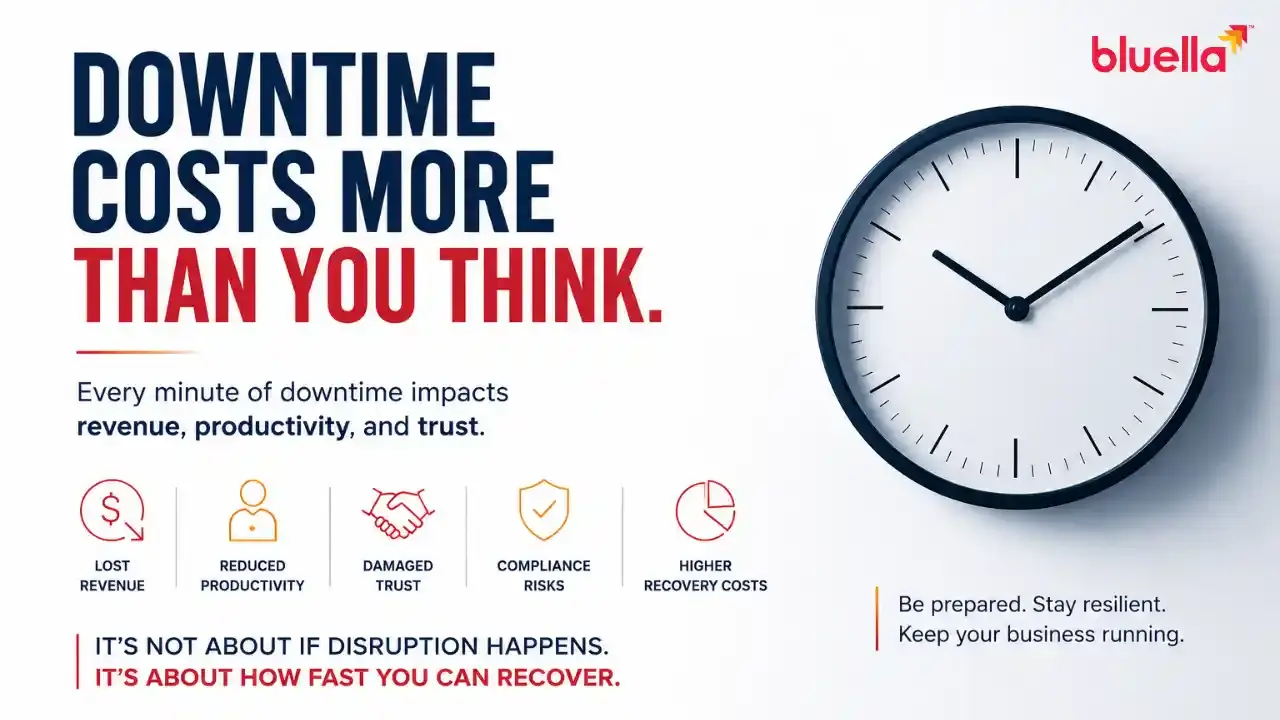
The Hidden Cost of Downtime: What Every CEO Should Know
In today's digital economy, every second of downtime has a business impact.
Whether caused by a cyberattack, ransomware, hardware failure, human error, or an unexpected disaster, downtime is no longer just an IT problem—it's a business risk that affects revenue, customer trust, productivity, and long-term growth.
For CEOs and business leaders, the question isn't "Can we prevent every disruption?"
The real question is:
"How quickly can our business recover?"
Organizations that prioritize Business Continuity, Disaster Recovery, and Cyber Resilience don't just survive disruptions—they recover faster, minimize losses, and maintain customer confidence.
Downtime Costs More Than You Think
Many organizations underestimate the ripple effect of downtime.
A single outage can lead to:
Lost revenue from interrupted operations
Reduced employee productivity
Delayed customer deliveries
Missed business opportunities
Compliance and regulatory risks
Damage to brand reputation and customer trust
The longer critical systems remain unavailable, the greater the financial and operational impact.
In an increasingly connected business environment, recovery speed directly influences business performance.
Downtime Isn't Just Caused by Cyberattacks
While ransomware and cyber threats continue to grow, they aren't the only reasons organizations experience downtime.
Common causes include:
Hardware and infrastructure failures
Cloud service disruptions
Human error
Software failures
Power outages
Natural disasters
Network failures
Data corruption
No organization is immune.
Preparation—not prediction—is what separates resilient businesses from vulnerable ones.
The Real Cost Isn't the Outage. It's the Recovery Time.
Most organizations focus on preventing outages.
Successful organizations focus on recovering quickly.
Every additional minute spent recovering can mean:
More revenue lost
Greater operational disruption
Higher recovery costs
Lower customer confidence
This is why enterprise leaders now measure resilience through Recovery Time Objective (RTO) and Recovery Point Objective (RPO)—two critical metrics that determine how quickly systems can be restored and how much data can be recovered after an incident.
Fast recovery isn't just an IT objective.
It's a business strategy.
Why Backup Alone Isn't Enough
Many businesses believe having backups means they're protected.
Unfortunately, that's only part of the solution.
A backup is simply stored data.
Without a well-designed Disaster Recovery Strategy, organizations may still struggle to restore applications, infrastructure, and critical business operations quickly enough to avoid significant disruption.
Modern enterprises require:
Automated Backup & Disaster Recovery
Secure Cloud Backup
Rapid Recovery Capabilities
Business Continuity Planning
Continuous Data Protection
Cyber Resilience Strategies
Because backups don't keep businesses running.
Recovery does.
Building a Business That Can Recover Faster
Business resilience starts long before an incident occurs.
Organizations should regularly evaluate:
Is our critical business data adequately protected?
How quickly can we restore business operations?
Are our backups tested regularly?
Do we have a documented Disaster Recovery Plan?
Can our infrastructure recover from ransomware or hardware failures?
Are we prepared for both on-premises and cloud disruptions?
The answers to these questions determine how prepared an organization truly is.
Business Continuity Is a Competitive Advantage
Today's most resilient organizations view Business Continuity as an investment—not an expense.
A strong continuity strategy enables businesses to:
Reduce operational downtime
Improve cyber resilience
Protect critical business data
Maintain customer confidence
Meet regulatory and compliance requirements
Ensure uninterrupted business operations
In a competitive market, resilience becomes a strategic advantage.
How Bluella Helps Businesses Stay Resilient
At Bluella, we help organizations strengthen their Backup & Disaster Recovery, Business Continuity, and Cloud Infrastructure with solutions designed for today's evolving business challenges.
Our approach focuses on:
Enterprise Backup Solutions
Disaster Recovery Planning
Business Continuity Solutions
Cloud Backup & Recovery
Data Protection
Cyber Resilience
Infrastructure Monitoring
24×7 Technical Support
Because every business deserves the confidence to recover quickly when the unexpected happens.
Final Thoughts
Disruption is inevitable.
Extended downtime doesn't have to be.
Organizations that invest in Business Continuity, Disaster Recovery, and Cyber Resilience are better positioned to protect revenue, maintain customer trust, and recover with confidence.
The next outage may be unpredictable.
Your recovery strategy shouldn't be.
Looking to strengthen your organization's resilience?
Connect with Bluella to build a future-ready Backup & Disaster Recovery strategy that keeps your business running—no matter what comes next.